
Security systems deployment designed around manufacturing operations
Protect production, people, materials and critical infrastructure without treating a working plant like an ordinary office.
Start with the operating environment
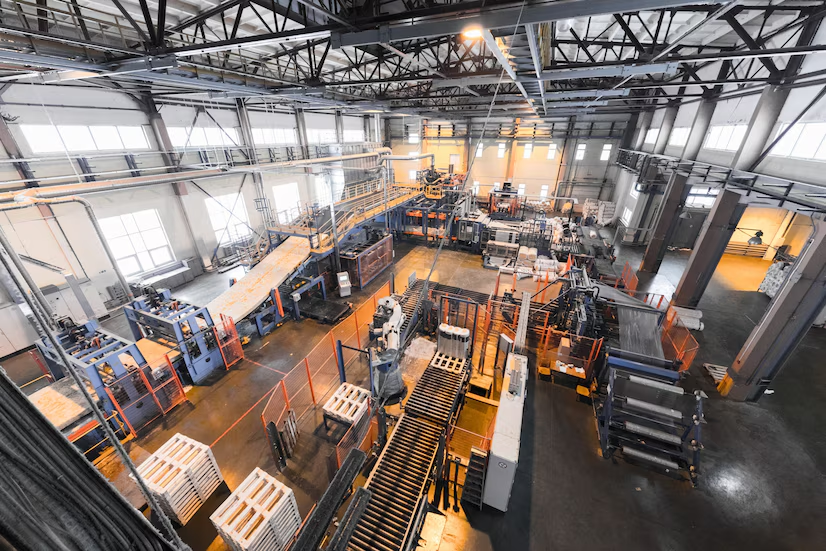
Manufacturing security begins with the way the plant actually runs: shift changes, employee and contractor entrances, material receiving, truck circulation, outdoor storage, production cells, laboratories, tool rooms and critical utilities. A useful assessment separates routine property protection from higher-consequence areas such as control rooms, recipes, quality records, hazardous materials and operational technology. It also identifies where a security response must be coordinated with safety and production leadership rather than initiated automatically.
The site survey must be performed during representative operating conditions. Daytime observations may not reveal overnight lighting, shift-change congestion, remote gate staffing, weekend scheduled maintenance or trailer accumulation. Dust, vibration, washdown, temperature, long cable distances and electromagnetic conditions can change the correct camera, reader, enclosure, pathway and communications deployment design. Line moves and new racking also alter sightlines and access routes after the initial on-site installation.
Security zones that need different decisions
A manufacturing security systems scope must distinguish these operating areas before equipment is selected.
Build the system around owned workflows
A layered plant deployment design can combine controlled pedestrian and vehicle entry, visitor and contractor credentials, intercom, video surveillance, intrusion detection, electronic door hardware and protected control-room access. Each integration needs a named owner and a defined event. Connecting security directly to machinery or process controls is not assumed; any IT/OT interface must be reviewed by the responsible controls, cybersecurity and safety teams.
Credential rules must reflect employment status, shift, training, sponsor, work zone and expiration. Contractors may need bounded schedules and escorted areas instead of broad plant access. Video views must document a defined activity—vehicle approach, material transfer, perimeter movement, production-area entry or incident sequence—and must be tested under real lighting, motion and obstruction conditions.
Vehicle and gate control
Coordinate credentials, intercom, loops, LPR where appropriate and safe gate fallback.
Industrial video
Select views, housings and mounting for lighting, height, dust, vibration and process obstruction.
Restricted-area access
Apply role, schedule, training and sponsor requirements to production and utility zones.
Incident integration
Route alarms and video verification to plant roles with clear escalation and audit history.
Test the operating result—not only the devices
Operational Acceptance must exercise peak entry, rejected credentials, forced and held doors, gate tailgating, loading activity, perimeter alarms, operator acknowledgement, video retrieval and the approved loss-of-power or communications procedure. A green device status is not acceptance. Evidence must show that the right person received the event, understood the location and completed the documented response without disrupting a safety-critical process.
Plant closeout must include zones, roles, door and gate logic, camera purpose and view, retention, network and power dependencies, alarm priorities, test evidence and protected drawings. Ongoing ownership includes contractor expiration, credential review, camera health, lens cleaning, gate safety, configuration backup and change review after construction, new equipment or production-layout changes.
| Scenario | Required outcome | Acceptance evidence |
|---|---|---|
| Shift change | Fast authorized flow without uncontrolled tailgating | Peak-flow observation and credential audit |
| Contractor visit | Sponsor, bounded zone, schedule and expiration | Visitor record and access-event sample |
| Truck arrival | Vehicle identification, gate decision and dock direction | Arrival/departure scenario evidence |
| Production incident | Relevant alarm, usable video and owned response | Timed multidisciplinary exercise |
Questions the deployment design must answer
- Which assets or processes create the highest operational consequence?
- How do employees, contractors, materials and vehicles move by shift?
- Which areas require escort, training, dual authorization or restricted schedules?
- What environmental ratings and scheduled maintenance access do field devices need?
- Who owns security events that intersect IT, OT, safety or production?
- Which changes require a new coverage and access review?
Frequently asked questions
Can plant security use ordinary office equipment?
Only where environmental ratings, pathways, power and performance meet the actual location.
Should security control machinery?
Not by default. Any connection to production or safety controls needs formal OT and safety review.
Why test during a shift change?
Peak traffic reveals gate capacity, tailgating and response issues that an empty-site test misses.
When must coverage be reassessed?
After line, racking, yard, door, lighting, shift or restricted-process changes.
Official deployment planning resources
These public manufacturing security systems resources provide deployment planning context; site program requirements still need site- and jurisdiction-specific review.
Detailed deployment planning and product-family guides
Explore the detailed manufacturing security systems guides below to compare options, dependencies and site program decisions.
Plan your manufacturing security systems site program
Share the operating schedule, existing systems, known risks and desired timing for this manufacturing security systems environment. We can help define the survey, deployment design and acceptance work.
Start a site program conversation